Full transcript of keynote speech at CI World Congress in Hong Kong from EU Commissioner for Climate Action, Connie Hedegaard: Empowering consumers in the green economy

Showing posts with label Climate change. Show all posts
Showing posts with label Climate change. Show all posts
Wednesday, 4 May 2011

Summary: Opening Ceremony, CI World Congress 2011
A summary of the speeches made at this morning's Opening Ceremony to Consumers International World Congress 2011. By Robin Simpson.
 HKCC Chairman Anthony Cheung opened proceedings asserting the greater than ever need for a consumer movement as in the light of “the explosion of consumer issues”. Current crises were both economic, such as the financial crisis and its linked policies such as quantitative easing, and environmental such as the current radiation crisis in the region. HKCC was proud to have contributed since the last World Congress in HK 20 years ago and he welcomed the new legislative package on competition and trade descriptions, and the continued support of the SAR. He welcomed the presence of the largest ever delegation from mainland China, over 200, at a World Congress, referring to China as both the largest factory and the largest consumer market in the world in the fastest growing economic region. In all, the Congress welcomed over 700 delegates from over 60 jurisdictions.
 HKCC Chairman Anthony Cheung opened proceedings asserting the greater than ever need for a consumer movement as in the light of “the explosion of consumer issues”. Current crises were both economic, such as the financial crisis and its linked policies such as quantitative easing, and environmental such as the current radiation crisis in the region. HKCC was proud to have contributed since the last World Congress in HK 20 years ago and he welcomed the new legislative package on competition and trade descriptions, and the continued support of the SAR. He welcomed the presence of the largest ever delegation from mainland China, over 200, at a World Congress, referring to China as both the largest factory and the largest consumer market in the world in the fastest growing economic region. In all, the Congress welcomed over 700 delegates from over 60 jurisdictions.
 Chief Executive Hon Donald Tsang of HK SAR asserted HK’s commitment to the free flow of information, and the role of NGOs and the free media. HK as a major economic and tourist hub received 36 million visitors per year far greater than its population of seven million. It was now the world’s top location for luxury brands, underpinned by advanced consumer protection legislation. HK participated fully in supra-national ‘framework’ organisations such as APEC, WTO.
Samuel Ochieng, president of Consumers International, drew the attention of Congress to CI’s recent successes putting CP in financial services at the heart of the G20 agenda, strengthening the WHO’s work on marketing of junk food to children and successfully contributing to the recent completion of the ISO standard on corporate social responsibility. COs needed to adapt to the new digital world in which Twitter had as many adherent as the population of Brazil, and Facebook as many as the US. Mr Ochieng's full speech is available here.
Connie Hedegaard, EU Commisioner for Climate Action
Keynote address: Empowering consumers in the green economy
Climate change has arrived: The Commissioner delivered a rousing call to action by consumers on climate change. Governments could set targets and standards but only consumers had the “power of the purse” to implement climate policies at purchasing level. Two startling facts to start: 2010 was the hottest year on record, and also the year with the most precipitation.
The world’s population was approaching 9 billion within her children’s lifetime while it was below 2 billion when her grandmother was born. These trends had consequences for the world’s resources, for example: each day we cut and burn 24,000 football pitches of forest, and today’s fishing fleet accounted for seven times the catch of the global fleet in 1950. Extreme weather events were already happening, as witnessed recently in Pakistan, Russia, Australia. Climate scientists were forecasting a 4 degree rise in temperature by the end of the century.
Rising demand: There would be one billion new members of the ‘middle class’ by 2050 and on current trends, we would need 2.5 ‘new planets’ by 2050 in resource terms. The terms ‘rich’ and ‘poor’ no longer applied to countries but to populations within countries. Nearly half the world’s middle class consumers were now in developing countries with 240 million in China and 120 million in India. This year we are paying 40% more for food than we did last year.
Household consumption has a huge impact, 70% of GHG emissions come from households, 40% from buildings alone in the EU. Meat needs 10 times more energy than locally sourced vegetables, and EU households throw away 25% of their food purchases. The average plastic bag is used for only five minutes but takes 500 years to decompose.
Green growth model: We need to embrace the green growth model, major reductions in emissions were cost effective so that even climate change sceptics should be able to accept the economic case for them. “There is no cheaper energy than the energy we don’t use”. Environmental industries were creating jobs, for example, investment in renewables was creating 3-5 times more jobs per dollar than fossil fuels. The EU now had 3-4 million jobs in ‘environmental industries, China is now the world’s top producer of solar panels and accounts for 40% of the global total of investment in clean technology.
We need to decouple rising emissions from economic growth. In the EU in recent years, emissions have fallen while growth has taken place. Regulation plays a part: in the EU new car emissions have fallen 25% since 2006 following new regulations. It is hard for consumers to not be confused by the plethora of labelling, but accurate labelling can help. Class A fridge/freezer labels introduced in 1995 only covered two per cent of output then, but this has risen to over 90% now. Consumers who bought a grade A fridge in 1995 would have saved over 1,000 euros by now. Environmental labelling and information needs to smarten up to new media allowing for search facilities online, smart metering can help consumers monitor their own consumption.
The final hurdle is that we must persuade consumers to systematically buy sustainably, that it is “cool to use less”. “We are threatening the planet with our patterns of consumption” “Business as usual is no longer an option”.
Wednesday, 19 May 2010
Rio Earth Summit 2012: Anything less than visionary action from our world leaders is greenwashing
Luke Upchurch of Consumers International on the aims of the Green Economy Coalition
Let's get one thing straight: the “Green Economy” is not a buzz word, nor a sound bite, nor the nom du jour. It is not a distraction to the discussions on sustainable development – it fundamentally underpins sustainable development.
While some may rightly argue that the UN's focus on the Green Economy here at the UNCSD Rio 2012 preparations meeting does not mean government delegates necessarily understand or support the concept, we have seen some genuine attempts by some countries and UN bodies to engage with the issue. The issue now needs to be advanced in a way that recognises the fundamental flaws in our economic system that have led to the crises we are experiencing today. As the NGO statement to the negotiations put it today “anything less is just greenwash”.
So what does Green Economy mean? And what can it achieve? One group that is trying to put workable ideas and tangible solutions on the table is the Green Economy Coalition (GEC).
The GEC brings together environment, development, trade union, consumer and business sectors, North and South committed to a common cause: accelerating a transition to a new green inclusive economy. Leading members of the GEC are here in New York to launch Green, fair and productive: How the 2012 Rio Conference can move the world towards sustainability. It provides an explanation of the practical actions needed to tackle these shared concerns.
The GEC argues that in the current global economic framework, perverse incentives, weak legislation and poor labour standards have not only neutralised many potential benefits of globalisation, but have accelerated negative impacts on the environment, workers, consumers and economic stability. While global poverty has become entrenched, unsustainable consumption has increased.
These problems are complex and widespread, but the GEC believes real solutions exist and that Rio 2012 offers a precious opportunity for world leaders to turn around the failed approaches of the recent past.
By focusing on accountability, national dialogue, the transformation of current governing systems, and a collective effort to learn from what actually works, the GEC believes Rio 2012 can put us on a path towards the new economic paradigm needed to finally achieve the goals of Rio 1992.
At the 18 May launch of Green, fair and productive at the UN in New York, Tom Bigg of the International Institute for Environment and Development (IIED, the secretariat of the GEC) laid out the shared vision of the Coalition: “ A resilient economy that provides a better quality of life for all within the ecological limits of one planet.” A clear goal, made only more compelling by the range of partners in the coalition; represented on the panel by leaders from the Global South, the consumer movement and trade unions.
Shrashtant Patara of Development Alternatives in India explained how the GEC principles were set to become practice through the Coalition's focus on national dialogue as a catalyst for transformation. Patara stressed the importance of this aspect, as without national policy change the objectives of the GEC would remain above the political and legislative arenas in which they needed to work. These include national awareness raising activities and a focus on 'roadmapping' the changes needed. Embedded in this process is a condition to share these experiences with other countries, a key part of the GEC national dialogue vision.
Consumers International's Bjarne Pedersen outlined the coalition's specific asks, emphasising the importance of addressing the demand-side of the problems we face. This included a 'sharper focus' on corporate accountability and using Rio 2012 as a platform for further formalising standards for sustainable corporate behaviour. Pedersen also highlighted some of the critical steps: bold political leadership, regulating industry to better protect and serve consumer protection and labour rights, an end to GDP as the main benchmark measurement of progress, and an internalisation of the real costs of goods and services so sustainable lifestyle choices become the mainstream.
And Anabella Rosemberg of the International Trade Union Confederation (ITUC) explained how green and decent jobs are a real opportunity in the transition towards a more sustainable society, but that simply developing new sectors will not be enough: we need to speed up our efforts to green all our economic sectors. The GEC stresses that a "just transition" needs investments, education and training, social protection and dialogue and local diversification strategies.
The Green Economy Coalition has managed to fuse a myriad of approaches into a coherent set of shared concerns. The focus on increasing action and accountability stands in marked contrast to the difficulty in achieving change through current negotiating frameworks – a point recognised by several participants at the event. Respondents from the Danish and Brazilian governments, the ILO, UNEP and UNDP also welcomed the creation of the Coalition and its plans over the next two years.
The GEC is providing bold and specific details for change. Wholesale transformation of financial regulation, an end to short-term incentives, and a phasing out of fossil fuelled, consumption-based growth are approaches that can put us on a path towards the new green economic paradigm that the vast majority of the world knows we need. This is not token tinkering around the edges, not another set of conditions forced on the Global South, and not greenwash. Governments would do well to take note.
Saturday, 27 March 2010
How can we raise climate consciousness in consumers?
Luke Upchurch reports back from the Product Carbon Footprint (PCF) World Summit, Berlin, March 2010.

But back to carbon. What became clear over the two-day summit was that there is a need to start seriously looking at how climate consciousness is raised: how GHG reduction is communicated. The PCF events continually demonstrate that there is some excellent, coordinated thinking on product life cycle analysis. But for this great work to translate into something tangible for the consumer, we need to get the great marketing minds of the world involved in the debate.
What is the PCF World Summit?
The PCF World Summit is a unique place to talk about climate change and consumption, as it provides a huge variety of opinion on what can be done to reduce the green house gas (GHG) impact of products and services.
Scientists, policy-makers, product designers, standards setters and civil society groups from across the world come together to bang heads about what works, what doesn’t , what needs attention and what needs to be avoided at all costs. These interviews give you a good flavour of the range of excellent contributions
Consumer perspective
This is the second time CI has been invited to present just how important it is to maintain trust and confidence among consumers, if the scientific and legislative initiatives are going to actually reduce GHG.
I arrived with a very clear message that it’s vital companies avoid over-playing the impact of their ‘green’ products (check out our Greenwashing awards for more on this); that marketing departments look at the larger challenge of raising climate consciousness, rather than just the eco-credentials of individual products; and that policy-makers do not get too obsessed with the power of carbon footprint labelling.
What other challenges to raising climate consciousness do you see?
Wednesday, 13 January 2010
In the crowd at Copenhagen
A report from CI’s Climate change policy intern Maherunesa, who went to Copenhagen after winning a place with the Platform 2 Countdown to Copenhagen Pledge Competition.
Away from the Bella Center, a crowd of 100,000 gathered in central Copenhagen ready to march for climate justice. The global need for civil society to make a stand against climate change was unmistakable, as protestors had come from all over the world, including Bangladesh and Cameroon. This truly emphasised the universal aim of the crowd – to empower the voices that are not being heard, the voices of those already being affected by climate change.
Undeniably the atmosphere was electric as the determined crowd marched through the streets of Copenhagen with jubilant chants, costumes and props. One such spectacle included a Statue of Liberty relentlessly churning out smoke, reminding all those around of the target to reduce carbon emissions. Though the media had unfortunately chosen to focus on the very small number of irresponsible actions, it had been the peaceful and friendly atmosphere of the protest that really dominated the crowd.
In spite of the biting cold, demonstrators remained hopeful in pressuring world leaders to make a fair and binding deal. As the city crept into darkness, spirits remained high. The 4-mile march had entered the evening until finally the UN conference centre had been reached. Climate change already causes 300,000 deaths a year, and so as a reminder of this, a candle lit vigil had been held, with the crowd hoping that world leaders could stop this number from rising.
As the march came to a close, protestors felt confident that their message was clear – the world is aware of climate change and climate justice is needed now.
Though some may argue the march came to a somewhat chaotic end, the next day brought a strong sense of optimism as crowds gathered around to hear the charming Archbishop Desmond Tutu deliver an inspirational speech. Through his wit and warmth, Archbishop Tutu made the message clear – climate change affects everyone, and accordingly the crowd supported this notion. The UN Climate Change Chief, Yvo De Boer then made his presence on the stage where he received 512,894 pledges from around the world in support of a fair and binding deal at the UN conference. Yvo De Boer concluded by stating his hope to make the decision makers notice the vast number of people who are fighting for climate justice.
These positive events injected some much needed hope in Copenhagen, though it seems that the thousands of voices of civil society remained ignored within the Bella Centre. Nonetheless the events of the weekend were incredibly refreshing as they showed that so many people are aware of climate change and will still continue to fight for those who cannot.
Away from the Bella Center, a crowd of 100,000 gathered in central Copenhagen ready to march for climate justice. The global need for civil society to make a stand against climate change was unmistakable, as protestors had come from all over the world, including Bangladesh and Cameroon. This truly emphasised the universal aim of the crowd – to empower the voices that are not being heard, the voices of those already being affected by climate change.
Undeniably the atmosphere was electric as the determined crowd marched through the streets of Copenhagen with jubilant chants, costumes and props. One such spectacle included a Statue of Liberty relentlessly churning out smoke, reminding all those around of the target to reduce carbon emissions. Though the media had unfortunately chosen to focus on the very small number of irresponsible actions, it had been the peaceful and friendly atmosphere of the protest that really dominated the crowd.
In spite of the biting cold, demonstrators remained hopeful in pressuring world leaders to make a fair and binding deal. As the city crept into darkness, spirits remained high. The 4-mile march had entered the evening until finally the UN conference centre had been reached. Climate change already causes 300,000 deaths a year, and so as a reminder of this, a candle lit vigil had been held, with the crowd hoping that world leaders could stop this number from rising.
As the march came to a close, protestors felt confident that their message was clear – the world is aware of climate change and climate justice is needed now.
Though some may argue the march came to a somewhat chaotic end, the next day brought a strong sense of optimism as crowds gathered around to hear the charming Archbishop Desmond Tutu deliver an inspirational speech. Through his wit and warmth, Archbishop Tutu made the message clear – climate change affects everyone, and accordingly the crowd supported this notion. The UN Climate Change Chief, Yvo De Boer then made his presence on the stage where he received 512,894 pledges from around the world in support of a fair and binding deal at the UN conference. Yvo De Boer concluded by stating his hope to make the decision makers notice the vast number of people who are fighting for climate justice.
These positive events injected some much needed hope in Copenhagen, though it seems that the thousands of voices of civil society remained ignored within the Bella Centre. Nonetheless the events of the weekend were incredibly refreshing as they showed that so many people are aware of climate change and will still continue to fight for those who cannot.
Friday, 18 December 2009
COP15 says goodbye to Tuvalu
CI's Head of Delegation at COP15, Rasmus Kjeldahl, reflects on two chaotic weeks in Copenhagen
 At COP15 - where the only guarantee is that the agreement we have is considerably less ambitious and binding than many had hoped for - it is time to take stock of my organisation Consumer International's participation as an observer to the negotiations.
Overall, I must initially disappoint you; we have not been able to make a difference to the actual negotiations. Although we had not really expected to do that.
We have, however, become a lot wiser about how a COP meeting progresses and what the rules are - especially when just getting access to the negotiations is a huge challenge. Two of our delegation members from Brussels never entered the venue of the negotiations despite many hours of waiting in the biting cold.
If you want to influence the negotiations the way forward is to have good contacts with - and influence over - national delegations. It is beyond any doubt that many of the G77 countries did receive advice from NGO’s both before and during the COP15. The case of Tuvalu is a good example of this. The advice gives influence and helps to compensate poor nations for the lack of human resources to engage the negotiations.
Another lesson is that it is difficult to a balanced view from the media - the press were largely occupied with the activists who engaged in demonstrations or in direct actions. It is clear that the press bare some responsibility for promoting irresponsible actions and demonstrations and not promoting enough the many peaceful protests – such as our own Guardian Angels for Climate Protection.
Regarding the negotiations, it is hard not to be somewhat disillusioned with the confusion that has prevailed throughout. This applies both to the logistics around the COP and to the way in which negotiations proceeded - the involvement of NGOs was clearly not thought through and this has been a major contributor to the low mood of the delegates and to the poor outcome.
You get the feeling that the ability of the key negotiators to manage the process and the Danish ability to coordinate could have been better. This point should clearly be worked on and improved given the fact that Denmark, as the EU presidency country, will lead the EU delegation to the World Summit on Sustainable Development to be held in Brazil in 2012.
Regarding the outcome – well there is certainly enough to work with in Mexico at the next COP. However I do know that the outcome of Copenhagen is not good enough for the inhabitants of Tuvalu and the many other low-lying islands who will not be able to look confidently to the future.
 At COP15 - where the only guarantee is that the agreement we have is considerably less ambitious and binding than many had hoped for - it is time to take stock of my organisation Consumer International's participation as an observer to the negotiations.
Overall, I must initially disappoint you; we have not been able to make a difference to the actual negotiations. Although we had not really expected to do that.
We have, however, become a lot wiser about how a COP meeting progresses and what the rules are - especially when just getting access to the negotiations is a huge challenge. Two of our delegation members from Brussels never entered the venue of the negotiations despite many hours of waiting in the biting cold.
If you want to influence the negotiations the way forward is to have good contacts with - and influence over - national delegations. It is beyond any doubt that many of the G77 countries did receive advice from NGO’s both before and during the COP15. The case of Tuvalu is a good example of this. The advice gives influence and helps to compensate poor nations for the lack of human resources to engage the negotiations.
Another lesson is that it is difficult to a balanced view from the media - the press were largely occupied with the activists who engaged in demonstrations or in direct actions. It is clear that the press bare some responsibility for promoting irresponsible actions and demonstrations and not promoting enough the many peaceful protests – such as our own Guardian Angels for Climate Protection.
Regarding the negotiations, it is hard not to be somewhat disillusioned with the confusion that has prevailed throughout. This applies both to the logistics around the COP and to the way in which negotiations proceeded - the involvement of NGOs was clearly not thought through and this has been a major contributor to the low mood of the delegates and to the poor outcome.
You get the feeling that the ability of the key negotiators to manage the process and the Danish ability to coordinate could have been better. This point should clearly be worked on and improved given the fact that Denmark, as the EU presidency country, will lead the EU delegation to the World Summit on Sustainable Development to be held in Brazil in 2012.
Regarding the outcome – well there is certainly enough to work with in Mexico at the next COP. However I do know that the outcome of Copenhagen is not good enough for the inhabitants of Tuvalu and the many other low-lying islands who will not be able to look confidently to the future.
Thursday, 17 December 2009
Obama skipping COP15? We’ll have to settle for Schwarzenegger
CI Head of Delegation at COP15, Rasmus Kjeldah, reports on the lack of progress in Copenhagen
 The climate negotiations may end up with an elephant giving birth to a mouse.
Today’s reports at the internal briefing did not inspire much optimism. Tuesday night talks between G77 and the US were on the brink of collapse as the US put sharp brackets [around the entire text], i.e. declared that there was no agreement on anything. If that is the foundation of the further negotiations between Heads of State and government, it seems like an overwhelming job. Particularly with only 48 hours left.
The Danish text that was presented on Wednesday was soon labeled ‘as full of holes as a Swiss cheese’, and it will probably not form the basis of the further work. So everybody’s anxiously waiting for another proposal.
The EU is getting in an increasingly bad mood because they are the guys who receive most of the criticism in spite of the fact that the EU has presented the most ambitious and specific bid, both in terms of reduction commitment and finance.
Negotiations are now taking place in still smaller informal groups, which makes it possible to speed up the process – of course this also means that those who don’t participate may end up blocking negotiations because they feel that they are not represented. But surely there will be a deal – most probably about postponing the solution to COP16 in Mexico.
If we don’t see solid progress very soon, the crux of the remaining negotiations will probably be to avoid being made a scapegoat for the poor results. And then it’s hard to see any reason why Obama should come.
The author of this blog was also denied access to the Bella Centre today as it was blocked by the police following widespread demonstrations . Here I got a first-hand impression of the poor police communication and of the frustrations experienced in the long queue of world citizens who have legitimate invitations to participate. But, typically Danish, at least coffee was served in the queue…
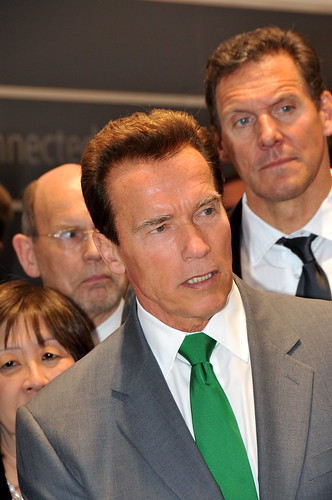
On the other hand I had the pleasure of listening to the Governator, Arnold Schwarzenegger (above), who at a meeting at the Copenhagen town hall accounted for his private climate adaptation: solar cell heated swimming pool, Hummer with a hybrid engine and no shower longer than five minutes for the kids. Good consumer advice which you are free to follow…
 The climate negotiations may end up with an elephant giving birth to a mouse.
Today’s reports at the internal briefing did not inspire much optimism. Tuesday night talks between G77 and the US were on the brink of collapse as the US put sharp brackets [around the entire text], i.e. declared that there was no agreement on anything. If that is the foundation of the further negotiations between Heads of State and government, it seems like an overwhelming job. Particularly with only 48 hours left.
The Danish text that was presented on Wednesday was soon labeled ‘as full of holes as a Swiss cheese’, and it will probably not form the basis of the further work. So everybody’s anxiously waiting for another proposal.
The EU is getting in an increasingly bad mood because they are the guys who receive most of the criticism in spite of the fact that the EU has presented the most ambitious and specific bid, both in terms of reduction commitment and finance.
Negotiations are now taking place in still smaller informal groups, which makes it possible to speed up the process – of course this also means that those who don’t participate may end up blocking negotiations because they feel that they are not represented. But surely there will be a deal – most probably about postponing the solution to COP16 in Mexico.
If we don’t see solid progress very soon, the crux of the remaining negotiations will probably be to avoid being made a scapegoat for the poor results. And then it’s hard to see any reason why Obama should come.
The author of this blog was also denied access to the Bella Centre today as it was blocked by the police following widespread demonstrations . Here I got a first-hand impression of the poor police communication and of the frustrations experienced in the long queue of world citizens who have legitimate invitations to participate. But, typically Danish, at least coffee was served in the queue…
On the other hand I had the pleasure of listening to the Governator, Arnold Schwarzenegger (above), who at a meeting at the Copenhagen town hall accounted for his private climate adaptation: solar cell heated swimming pool, Hummer with a hybrid engine and no shower longer than five minutes for the kids. Good consumer advice which you are free to follow…
Wednesday, 16 December 2009
Now or never at COP 15 – the US decides
CI Head of Delegation at COP15, Rasmus Kjeldahl, blogs from Copenhagen
 The United States plays a key role in deciding whether these climate negotiations shall succeed, and whether the targets agreed shall be implemented.
With a proposal of only a 4% reduction of emissions compared to 1990 level, and the world record in carbon emissions, the US performance has not commanded respect so far. This is in stark contrast to the charm offensive that the US launched at the Bella Centre today where celebrities such as Arnold Schwarzenegger (left), Daryl Hannah and Thomas Friedman all threw their lot in with the climate cause.
In spite of the strong messages, the audience was left with a feeling that there was more hot air than real action behind the words. Daryl Hannah (actress who has made herself an advocate of the environment) proposed that we should all grow more vegetables ourselves and that solar panels should be installed on top of the White House.
Another debate between five governors from the US and Canada showed a side of the US where people had actually understood that the transition to a new world order also offers new business opportunities and were ready to meet more ambitious targets than what the US have committed to.
But what about the US population at large? Do people understand that their country has to take the lead, both in terms of reducing emissions and transferring technology to developing countries so they can find a different development path to the one the rich countries have followed? The underlying tone in many of the presentations today has been that the US must take a much stronger leadership role if a deal is to meet world expectations.
Thomas Friedman from the New York Times pointed out that opponents of a global carbon tax have quite overlooked the fact that in the existing world order we accept paying an overcharge to a cartel of oil-producing countries. The current pressure on the world’s oil resources has led to an enormous transition of money from countries which are to a great extent undemocratic and unstable. Friedman argues it would be better if a global carbon tax could lower consumption and, consequently, producer prices, while at the same time the income could be used to finance long-term solutions to the world’s energy problems.
Here he points at something very crucial in the debate about global warming: the inherent advantages of economising on our limited energy resources and of securing a much higher degree of independence from unstable regimes. In this respect an ambitious climate policy may prove to be a win-win solution, no matter how much one believes humans contribute to global warming.
The atmosphere at the Bella Centre on Tuesday evening was characterised by frustration, nervousness and, frankly, chaos. Much time has been wasted advancing familiar points of view; the time is running out for reaching the basis for a deal that is ready to be presented to the world’s Heads of State.
The situation is also chaotic with regard to getting in and out of the Bella Centre and the general logistics of the event. As a Dane I do feel a little uneasy about the impression of Denmark that people may have got: delegates who are rejected after hours of waiting in the biting cold, not to mention ordinary citizens detained without reason by the police who were unable to distinguish between peaceful demonstrators and a small group of troublemakers.
 The United States plays a key role in deciding whether these climate negotiations shall succeed, and whether the targets agreed shall be implemented.
With a proposal of only a 4% reduction of emissions compared to 1990 level, and the world record in carbon emissions, the US performance has not commanded respect so far. This is in stark contrast to the charm offensive that the US launched at the Bella Centre today where celebrities such as Arnold Schwarzenegger (left), Daryl Hannah and Thomas Friedman all threw their lot in with the climate cause.
In spite of the strong messages, the audience was left with a feeling that there was more hot air than real action behind the words. Daryl Hannah (actress who has made herself an advocate of the environment) proposed that we should all grow more vegetables ourselves and that solar panels should be installed on top of the White House.
Another debate between five governors from the US and Canada showed a side of the US where people had actually understood that the transition to a new world order also offers new business opportunities and were ready to meet more ambitious targets than what the US have committed to.
But what about the US population at large? Do people understand that their country has to take the lead, both in terms of reducing emissions and transferring technology to developing countries so they can find a different development path to the one the rich countries have followed? The underlying tone in many of the presentations today has been that the US must take a much stronger leadership role if a deal is to meet world expectations.
Thomas Friedman from the New York Times pointed out that opponents of a global carbon tax have quite overlooked the fact that in the existing world order we accept paying an overcharge to a cartel of oil-producing countries. The current pressure on the world’s oil resources has led to an enormous transition of money from countries which are to a great extent undemocratic and unstable. Friedman argues it would be better if a global carbon tax could lower consumption and, consequently, producer prices, while at the same time the income could be used to finance long-term solutions to the world’s energy problems.
Here he points at something very crucial in the debate about global warming: the inherent advantages of economising on our limited energy resources and of securing a much higher degree of independence from unstable regimes. In this respect an ambitious climate policy may prove to be a win-win solution, no matter how much one believes humans contribute to global warming.
The atmosphere at the Bella Centre on Tuesday evening was characterised by frustration, nervousness and, frankly, chaos. Much time has been wasted advancing familiar points of view; the time is running out for reaching the basis for a deal that is ready to be presented to the world’s Heads of State.
The situation is also chaotic with regard to getting in and out of the Bella Centre and the general logistics of the event. As a Dane I do feel a little uneasy about the impression of Denmark that people may have got: delegates who are rejected after hours of waiting in the biting cold, not to mention ordinary citizens detained without reason by the police who were unable to distinguish between peaceful demonstrators and a small group of troublemakers.
Consumer dialogue with business is key to tackling climate change
CI Director General, Joost Martens, on talking with business at Copenhagen
The actions of business are vital to any chance we have of avoiding runaway climate change. Corporations need to respond both to government legislation and consumers’ desire to take individual actions. This dynamic makes dialogue with business leaders an important undertaking at COP15 and one that drew me to an event organised by the Copenhagen Climate Council.
Working in collaboration with the UN Global Compact, the New leadership for a sustainable economy event looked at the roles and responsibilities of business in relation to climate change.
Billed as an attempt to ‘kick-start the low-carbon revolution’, there was much talk at the event about the need for establishing the business case for climate action, the market potential of green technology, and the concept of ‘corporate climate responsibility’.
Many of the multinational corporations present were quick to reel out examples of commitments to low carbon usage in their supply chains, and of alliances with WWF and Greenpeace on specific actions. There was also a great deal of discussion about the communications challenge, and about the need for businesses to reframe their messages - an issue that we have raised as a real consumer concern with our recent Bad Company Awards focus on corporate greenwashing.
'The voice of consumer is leading' and 'consumer preferences are key' are two things I heard time and again. Business believes that, while the technology is 'pushing' industry towards green options, the 'pull' of consumers is needed to move business in the right direction. A fair point, but I would argue that business must take the lead and be proactive in their adoption of low-carbon practices.
I came away from the event assured that these corporate world leaders understand the responsibilities they hold for reducing the human impact on the climate. But my fear remains that many in businesses still see this simply as a ‘communications challenge’ (or, rather, a marketing opportunity).
Pressure from the consumer movement is vital here, if we are to ensure that businesses realise that the problems are far, far deeper than messaging and marketing.
The actions of business are vital to any chance we have of avoiding runaway climate change. Corporations need to respond both to government legislation and consumers’ desire to take individual actions. This dynamic makes dialogue with business leaders an important undertaking at COP15 and one that drew me to an event organised by the Copenhagen Climate Council.
Working in collaboration with the UN Global Compact, the New leadership for a sustainable economy event looked at the roles and responsibilities of business in relation to climate change.
Billed as an attempt to ‘kick-start the low-carbon revolution’, there was much talk at the event about the need for establishing the business case for climate action, the market potential of green technology, and the concept of ‘corporate climate responsibility’.
Many of the multinational corporations present were quick to reel out examples of commitments to low carbon usage in their supply chains, and of alliances with WWF and Greenpeace on specific actions. There was also a great deal of discussion about the communications challenge, and about the need for businesses to reframe their messages - an issue that we have raised as a real consumer concern with our recent Bad Company Awards focus on corporate greenwashing.
'The voice of consumer is leading' and 'consumer preferences are key' are two things I heard time and again. Business believes that, while the technology is 'pushing' industry towards green options, the 'pull' of consumers is needed to move business in the right direction. A fair point, but I would argue that business must take the lead and be proactive in their adoption of low-carbon practices.
I came away from the event assured that these corporate world leaders understand the responsibilities they hold for reducing the human impact on the climate. But my fear remains that many in businesses still see this simply as a ‘communications challenge’ (or, rather, a marketing opportunity).
Pressure from the consumer movement is vital here, if we are to ensure that businesses realise that the problems are far, far deeper than messaging and marketing.
Tuesday, 15 December 2009
Boycotting negotiations and debating carbon footprint labelling
CI Head of Delegation at COP15, Rasmus Kjeldahl, blogs from Copenhagen
Chaos at the entrance to the Bella Centre has all day been an obstacle to the NGO observers’ participation in the COP15 negotiations.
The CI delegation was also affected by the problems so only few managed to get in. In spite of four hours waiting time in the biting cold our newly arrived colleagues from Brussels didn’t manage to get an entry pass – they will try their luck again first thing tomorrow morning. During this week the NGO chances of participating will be further curbed as the some 130 Heads of State arrive.
There is now growing concern about whether results can actually be achieved, and a group of African countries demonstrated their dissatisfaction by boycotting the official negotiations and only participating in informal meetings. The reason is the rich countries’ very sparse promises so far to fund the initiatives needed to alleviate the effects of global warming. There are also demands for larger compensation for the deforestation which in itself is responsible for a large share of the carbon increase in the atmosphere.
Everybody is anxiously waiting to see whether the Danish presidency can get negotiations moving again. In the inner city there is a massive force of police and a series of demonstrations with quite a lot of arrests. It is expected that the current negotiation situation may increase the dissatisfaction among the protesters.
Consumers International, together with the Danish Consumer Council, hosted a well-attended discussion meeting in Copenhagen on Monday. The theme was climate change and the labelling of products, in particular food products. The key question is whether labelling of products may make it easier for consumers to make climate-friendly choices and, if so, what form of labelling is needed. Many labelling schemes breed confusion rather than providing guidance, e.g. it’s uncertain whether consumers can make use of information that a bag of crisps is associated with 75 g of carbon emissions. Is that much or little? And what is the climate-friendly alternative? Whether you choose to label or to use legislation or taxes to promote climate-friendly choices, there is a need to know the products’ carbon footprint, and a need for consensus on a calculation method.
Speaking at the discussion CI Director of Operations, Bjarne Pedersen, pointed out that the consumer focus should be on housing, food and transport, which overall account for the largest share of consumers’ climate impact, and where consumers actually have the option to choose other strategies – as long as governments and business provide the right framework.
In relation to food there was a prolonged discussion about whether local food is preferable. The message however is that transport only accounts for an average of 15 % of food related carbon emissions. In the holistic perspective it is often more desirable to produce food where the natural conditions are best suited, instead of, for instance, producing tomatoes in heated greenhouses. But choosing food of the season is also a good strategy for individual consumers.
In order for consumers to be able to make climate-friendly choices in relation to housing and transport there is very much a need for overall efforts to improve public transport systems and for increased requirements for buildings.
More on CI's approach to product carbon footprinting and labelling.
Chaos at the entrance to the Bella Centre has all day been an obstacle to the NGO observers’ participation in the COP15 negotiations.
The CI delegation was also affected by the problems so only few managed to get in. In spite of four hours waiting time in the biting cold our newly arrived colleagues from Brussels didn’t manage to get an entry pass – they will try their luck again first thing tomorrow morning. During this week the NGO chances of participating will be further curbed as the some 130 Heads of State arrive.
There is now growing concern about whether results can actually be achieved, and a group of African countries demonstrated their dissatisfaction by boycotting the official negotiations and only participating in informal meetings. The reason is the rich countries’ very sparse promises so far to fund the initiatives needed to alleviate the effects of global warming. There are also demands for larger compensation for the deforestation which in itself is responsible for a large share of the carbon increase in the atmosphere.
Everybody is anxiously waiting to see whether the Danish presidency can get negotiations moving again. In the inner city there is a massive force of police and a series of demonstrations with quite a lot of arrests. It is expected that the current negotiation situation may increase the dissatisfaction among the protesters.
Consumers International, together with the Danish Consumer Council, hosted a well-attended discussion meeting in Copenhagen on Monday. The theme was climate change and the labelling of products, in particular food products. The key question is whether labelling of products may make it easier for consumers to make climate-friendly choices and, if so, what form of labelling is needed. Many labelling schemes breed confusion rather than providing guidance, e.g. it’s uncertain whether consumers can make use of information that a bag of crisps is associated with 75 g of carbon emissions. Is that much or little? And what is the climate-friendly alternative? Whether you choose to label or to use legislation or taxes to promote climate-friendly choices, there is a need to know the products’ carbon footprint, and a need for consensus on a calculation method.
Speaking at the discussion CI Director of Operations, Bjarne Pedersen, pointed out that the consumer focus should be on housing, food and transport, which overall account for the largest share of consumers’ climate impact, and where consumers actually have the option to choose other strategies – as long as governments and business provide the right framework.
In relation to food there was a prolonged discussion about whether local food is preferable. The message however is that transport only accounts for an average of 15 % of food related carbon emissions. In the holistic perspective it is often more desirable to produce food where the natural conditions are best suited, instead of, for instance, producing tomatoes in heated greenhouses. But choosing food of the season is also a good strategy for individual consumers.
In order for consumers to be able to make climate-friendly choices in relation to housing and transport there is very much a need for overall efforts to improve public transport systems and for increased requirements for buildings.
More on CI's approach to product carbon footprinting and labelling.
Monday, 14 December 2009
Guardian Angels for Climate Protection
Julia Balz, of Germany's consumer group VZBV, on marching with angels in Copenhagen on Saturday.
 The global day of action against climate change on Saturday, 12 December got heavenly support: Five ‘Guardian Angels for Climate Protection’ joined the rally that marched the streets of Copenhagen.
Supporting the message that the political leaders have to agree to a legally binding treaty, the Angels not only brought a new thought to the demonstration and to the conference, they enlarged the friendly and peaceful atmosphere that was felt throughout the march.
Ten thousand people walked in beautiful sunshine but very cold temperatures to the Bella-Centre where the climate change talks are being held.
Sent out by CI and the German Federation of Consumer Organisations (VZBV) the Angels called for politicians to take consumers into account when negotiating green house gas-reductions.
The Angels were well welcomed by the other demonstrators from Finland, Norway, the United States, Malaysia, Korea, Germany, Sweden and many other countries. Passers-by not only wanted to touch their wings but also showed shared sympathy about their message. Many demonstrators agreed with a recent VZBV study: consumers are eager to protect the climate in their daily lives and in their consuming behaviour. But this is often neither easy nor even possible. There are not enough climate-friendly products and services out on the market and if they do exist, they are often hard to find, have a lower standard or are more expensive than the less climate-friendly products. So there is a lot to be done before it is easy for consumers to become guardian angels for the climate themselves.
But this is what the Angels are aiming for and they showed at the rally, how much fun it is to be a guardian angel and how easy this can get you and others into a good mood. That and the urgent need for changes to protect the climate is why the Angels demand politicians take consumers into account when negotiating green house gas-reductions.
 Consumers have to deal with the effects of climate change in their lives in more and more parts of the world. And they are the ones who can make an important difference when it comes to putting into action what the world leaders decide. But politicians need to think about where to cut green house gases so that the changes are just and make climate-friendly lifestyles attractive for consumers .
The Angels were quite surprised that not many people or politicians have thought about this correlation so far – to them it is obvious that everybody should have the chance of becoming a Guardian Angel for Climate Protection. Politicians of the world have to decide upon a treaty that is ambitious enough to protect the climate – and friendly to consumers.
 The global day of action against climate change on Saturday, 12 December got heavenly support: Five ‘Guardian Angels for Climate Protection’ joined the rally that marched the streets of Copenhagen.
Supporting the message that the political leaders have to agree to a legally binding treaty, the Angels not only brought a new thought to the demonstration and to the conference, they enlarged the friendly and peaceful atmosphere that was felt throughout the march.
Ten thousand people walked in beautiful sunshine but very cold temperatures to the Bella-Centre where the climate change talks are being held.
Sent out by CI and the German Federation of Consumer Organisations (VZBV) the Angels called for politicians to take consumers into account when negotiating green house gas-reductions.

The Angels were well welcomed by the other demonstrators from Finland, Norway, the United States, Malaysia, Korea, Germany, Sweden and many other countries. Passers-by not only wanted to touch their wings but also showed shared sympathy about their message. Many demonstrators agreed with a recent VZBV study: consumers are eager to protect the climate in their daily lives and in their consuming behaviour. But this is often neither easy nor even possible. There are not enough climate-friendly products and services out on the market and if they do exist, they are often hard to find, have a lower standard or are more expensive than the less climate-friendly products. So there is a lot to be done before it is easy for consumers to become guardian angels for the climate themselves.
But this is what the Angels are aiming for and they showed at the rally, how much fun it is to be a guardian angel and how easy this can get you and others into a good mood. That and the urgent need for changes to protect the climate is why the Angels demand politicians take consumers into account when negotiating green house gas-reductions.
 Consumers have to deal with the effects of climate change in their lives in more and more parts of the world. And they are the ones who can make an important difference when it comes to putting into action what the world leaders decide. But politicians need to think about where to cut green house gases so that the changes are just and make climate-friendly lifestyles attractive for consumers .
The Angels were quite surprised that not many people or politicians have thought about this correlation so far – to them it is obvious that everybody should have the chance of becoming a Guardian Angel for Climate Protection. Politicians of the world have to decide upon a treaty that is ambitious enough to protect the climate – and friendly to consumers.
Climate sceptics and climate villains
CI Head of Delegation at COP15, Rasmus Kjeldahl, on greenwashing and carbon quotas.
The Copenhagen climate summit provides an opportunity for climate sceptics to advance their views. It attracts attention when somebody swims against the tide, and among the thousands of climate researchers world-wide it is of course possible to find a few ones who speak against the rest. The BBC has made a very good account of the most common arguments made by climate sceptics
One of the more extreme arguments made by the sceptics comes from C02 is Green, who have gone as far as to claim more CO2 is actually good for the environment. See their US TV ad below.
The Copenhagen climate summit provides an opportunity for climate sceptics to advance their views. It attracts attention when somebody swims against the tide, and among the thousands of climate researchers world-wide it is of course possible to find a few ones who speak against the rest. The BBC has made a very good account of the most common arguments made by climate sceptics
One of the more extreme arguments made by the sceptics comes from C02 is Green, who have gone as far as to claim more CO2 is actually good for the environment. See their US TV ad below.
.
CO2 is Green was one of five winners of CI's Bad Company Awards 2009, which were announced last week. The oil-backed lobby group joined Audi, BP, Microsoft and easyJet as examples of some of the 'best' greenwashing of 2009.
When these companies market their products as being much more environmentally friendly than they actually are, they mislead consumers. This form of marketing does the climate cause a bad turn as it breeds confusion about genuinely climate friendly consumption choices. And it makes it hard for the serious corporations to penetrate the market with products that may actually make a difference.
A comparable problem in Denmark and some other countries has been the sale of so-called green power. Due to the interaction between the European quota system and political targets of increasing the share of renewable energy, in many cases it has been uncertain whether the increased price paid by consumers actually leads to the production of more environmentally friendly power.
Its also a problem for consumers who save electricity thanks to behavioral changes or the purchase of new low-energy appliances. They have found to their cost that as long as the total European CO2 quota remains unchanged, their lower energy consumption will not have an impact on emissions. On the contrary, the consumers’ eagerness to save energy just means that the CO2 quota price falls. This actually makes it cheaper for industry to pollute.
For a full explanation of the absurdity of emissions trading, see our policy position.
This is a crucial problem that must be solved if consumers are to make a real contribution to the fight against climate change. The design of the current quota system makes a mockery of consumer efforts. This will only breed inertia and indifference - the worst possible thing that can happen.
And now a brief update on life in the Consumers International delegation:
About one third of the delegation members were replaced this weekend, so now the delegation includes the CI President Samuel Ochieng, and Director for Operations, Bjarne Pedersen. The BEUC secretariat is represented by Laura Degaillaix and Sylvie Mauer. Apart from this we have received the aid of four German members from VZBV. On the other hand we have had to say goodbye to Jo Witt from the CI secretariat who has been an invaluable help all week. The extended delegation provides the opportunity to make new contacts to, for instance, EU politicians, national delegations and more green organisations.
The atmosphere in Copenhagen is getting more tense, and even though the streets are relatively calm, almost 1000 people were arrested during the big demonstration on Saturday (100,000 participants) – all but three were set free after a few hours though. The Danish police are very vigilant with an eye to avoiding any violence – this should also be seen in the light of the expected arrival of more than 110 heads of state this week.
Friday, 11 December 2009
Feelings and facts
CI Head of Delegation at COP15, Rasmus Kjeldahl, reflects on the first week in Copenhagen.
 The fight to stop global warming requires both feelings and facts.
Inside the Bella Centre (the venue for the Copenhagen climate change talks) these two incomparable characteristics meet in a sometimes chaotic process which is probably unsurpassed anywhere in the world.
Thousands of ardent NGO representatives from almost 900 grassroots organisations are attempting in a myriad of ways to formulate what problem should be solved. Some distribute low-key leaflets about the catastrophic consequences of climate change in a far corner of the world, others make street circus in the corridors of the Bella Centre with strolling trees and fabulous animals. All - like the supporters of Tuvalu's cause in the picture here - are attempting to call out to the world leaders that this time it is serious, that our future depends on a binding and ambitious deal.
Meanwhile just as many civil servants are negotiating long into the night in subgroups where wordings are turned over and over again and where the struggle is between a ’may’ or a ’shall’, and where even the definition of what ’shall’ means is a topic of discussion. New bodies are drawn up which, if adopted, will become a part of our world for many years to come. Should climate funding for the developing world be administered bilaterally, or should we establish a parallel to the World Bank with its own resources and global programmes? Will the Danish proposal on a global duty on ship fuel provide the funding needed? And what means of power are needed to make a deal binding in practice? This all needs to be in keeping with national constitutions and the very different decision-making processes around the world. Only very few people have an overview of all parts of the deal which will hopefully be made next week, and it seems like an almost insurmountable job to piece together a package which is so balanced that all 114 heads of state are prepared to accept it.
On day four the CI delegation made good progress with the task we have embarked on. We have achieved a reasonable overview of the most important negotiations. Through networks and meetings we have been in contact with the most important NGOs, and we have personally delivered a message to several negotiating delegations saying that the consumer organisations of the world must be involved in the further work to reach a deal. On Friday all country delegations will also receive a letter from us presenting the most important consumer issues which need attention. All this contributes to creating a platform for the further work to commit consumers worldwide to the climate issue.
In the days to come some members of the delegation will be replaced, which again may provide an opportunity to make new contacts. Follow the blog and see whether we succeed…
 The fight to stop global warming requires both feelings and facts.
Inside the Bella Centre (the venue for the Copenhagen climate change talks) these two incomparable characteristics meet in a sometimes chaotic process which is probably unsurpassed anywhere in the world.
Thousands of ardent NGO representatives from almost 900 grassroots organisations are attempting in a myriad of ways to formulate what problem should be solved. Some distribute low-key leaflets about the catastrophic consequences of climate change in a far corner of the world, others make street circus in the corridors of the Bella Centre with strolling trees and fabulous animals. All - like the supporters of Tuvalu's cause in the picture here - are attempting to call out to the world leaders that this time it is serious, that our future depends on a binding and ambitious deal.
Meanwhile just as many civil servants are negotiating long into the night in subgroups where wordings are turned over and over again and where the struggle is between a ’may’ or a ’shall’, and where even the definition of what ’shall’ means is a topic of discussion. New bodies are drawn up which, if adopted, will become a part of our world for many years to come. Should climate funding for the developing world be administered bilaterally, or should we establish a parallel to the World Bank with its own resources and global programmes? Will the Danish proposal on a global duty on ship fuel provide the funding needed? And what means of power are needed to make a deal binding in practice? This all needs to be in keeping with national constitutions and the very different decision-making processes around the world. Only very few people have an overview of all parts of the deal which will hopefully be made next week, and it seems like an almost insurmountable job to piece together a package which is so balanced that all 114 heads of state are prepared to accept it.
On day four the CI delegation made good progress with the task we have embarked on. We have achieved a reasonable overview of the most important negotiations. Through networks and meetings we have been in contact with the most important NGOs, and we have personally delivered a message to several negotiating delegations saying that the consumer organisations of the world must be involved in the further work to reach a deal. On Friday all country delegations will also receive a letter from us presenting the most important consumer issues which need attention. All this contributes to creating a platform for the further work to commit consumers worldwide to the climate issue.
In the days to come some members of the delegation will be replaced, which again may provide an opportunity to make new contacts. Follow the blog and see whether we succeed…
Thursday, 10 December 2009
Pushing the consumer perspective
CI Director General, Joost Martens, blogs from Copenhagen on influencing the decision makers.
One of our key goals in Copenhagen is to get the consumer angle on the map. This means a lot of lobbying, a lot of meetings with national delegates and a lot of relationship building if we are to influence opinion and decision-making.
Participation in many official and non-official meetings and events provides essential and useful building blocks for CI’s involvement and positioning. However at events like these it's important to read the situation on the ground, and that's why we felt we also needed to make a more general statement. Something that gives our targets an overall consumer perspective.
Having already prepared a booklet, Climate Change: The Consumer Perspective, for delegates at the venue, and published our policy positions online; we're now distributing a letter to the participating Heads of State and the heads of delegation.
Drafted by Rasmus (CI Head of delegation at COP15) and myself we set out the main reasons for consumer inclusion in the debate and the actions that need to be taken. At the same time, we are requesting leadership from governments for creating the conditions to make these crucial changes possible.
We'll be distributing this letter, together with the booklet, during the course of Thursday. And we'll also use it to target wider media coverage, during the relative lull over the next few days caused by Obama’s change of plans and the expected influx of people only attending over the weekend.
Tuvalu attack at COP15
CI Head of Delegation at COP15, Rasmus Kjeldahl continues his regular updates from inside the Copenhagen climate negotiations.
Consumer impact is just one of the many critical issues being discussed at Copenhagen. For some, like the residents of Tuvalu, climate change is an matter of immediate survival.
Many delegations from the South supported this demand and demanded that a new group was set up immediately with a view to drawing up a deal on this basis. This will require immediate and more extensive reductions in carbon emissions than have been agreed so far.
Tuvalu renders visible how serious the situation already is in many places in the world, but knowing how difficult it will be to reach agreement on a deal that keeps warming below 2 degrees, I’m afraid there is reason to be somewhat pessimistic about the future of Tuvalu. Sympathy is not sufficient to reach a result – there is also a need for money. A lot of money if the developing countries can have it their own way, less money according to the rich world. And there is a need for real GHG emissions reductions.
The conference fatigue starts to be visible in the faces of the delegates. The same food every day, a lot of coffee and the lack of fresh air can be felt. Physical endurance will be a critical factor to gaining influence for the next nine days…
Consumer impact is just one of the many critical issues being discussed at Copenhagen. For some, like the residents of Tuvalu, climate change is an matter of immediate survival.
Tuvalu, a small island nation threatened to be inundated by the Pacific Ocean, became today’s subject of conversation and campaigning at COP15. At the forenoon plenary session Tuvalu called on a higher level of ambition: they demanded a deal limiting the maximum global warming to 1.5 degrees Celsius.
Many delegations from the South supported this demand and demanded that a new group was set up immediately with a view to drawing up a deal on this basis. This will require immediate and more extensive reductions in carbon emissions than have been agreed so far.
The matter of money was also the focus of several meetings today. Many people are concerned that the funding of climate measures will be taken from the aid to developing countries and that as a result we will just see a new internal distribution among them. So instead of investments in education and economic development funding will be redirected into the building of seawalls and wind power.
Among other slightly surprising subjects of debate was an argument between the Chinese delegation and the secretariat. The bone of contention was partly that a Chinese minister had been stopped twice by the security guards who had confiscated his badge (which threatened to provoke a minor diplomatic crisis), and partly dissatisfaction with the conference logo which according to the Chinese (and other delegations) signaled that the Kyoto Protocol was not important anymore. The conference fatigue starts to be visible in the faces of the delegates. The same food every day, a lot of coffee and the lack of fresh air can be felt. Physical endurance will be a critical factor to gaining influence for the next nine days…
Wednesday, 9 December 2009
Problematic quotas and Climate-Gate
CI Head of Delegation at COP15, Rasmus Kjeldahl updates on Tuesday's proceedings in Copenhagen.
The size of the full strength CI delegation has meant information, rumours and ideas are now coming thick and fast. This has led to a slightly chaotic morning meeting and has clearly displayed the need to lay down a slightly tighter framework for our work in order to get the full benefit.
We are now fully immersed in the COP15 (the official name for the Copenhagen talks) universe, where it is key to quickly get on top of the abbreviations, lingo and insider jargon. This familiarity has bred some impatience and the CI delegation is keen to raise the CI profile at the conference venue and, in particular, have our positions presented to the negotiating delegations. We therefore decided to prepare a letter to the negotiating delegations about our consumer demands. The letter will be sent by Thursday, and I’ll report back on it later in the week.
Many consumer-relevant issues depend directly on the negotiations. For instance the introduction of tradable emissions quotas means that many consumers’ voluntary efforts to reduce the electricity consumption or buy climate-friendly power have no effect since it just leads to falling quota prices. As a result it becomes cheaper for industry to pollute. This probably never was the intention and we therefore need a system where consumers’ voluntary contributions directly reduce the total amount of emissions. Find out more about this in our position paper on consumer voluntary action on climate change.
All things considered there is cause to be sceptical about the quota systems as long as there is no political will to set ceilings at a level that puts real pressure on industry to reduce emissions. In the long term it is also unacceptable that the most energy-consuming industries get the quotas for free – it is exactly by increasing their costs that the consumption of their products could be reduced.
Among today’s events was a meeting under the auspices of the IPCC (Inter-governmental Panel on Climate Change), to deal with the so-called Climate-Gate: emails hacked from scientists who apparently seek to suppress and edit data not supporting the theories behind global warming. The chair of the panel R.K. Pachauri made it convincingly clear that these emails were not evidence that data had been hidden or edited and that besides it was a very open process with hundreds of nominated scientists whose work was commented on by other experts and approved by governments. The IPCC had not been asked to make their own investigation of the matter, but saw it as a matter for the police. No doubt it was a publicity stunt carefully designed to poison the negotiations at COP15.
The size of the full strength CI delegation has meant information, rumours and ideas are now coming thick and fast. This has led to a slightly chaotic morning meeting and has clearly displayed the need to lay down a slightly tighter framework for our work in order to get the full benefit.
We are now fully immersed in the COP15 (the official name for the Copenhagen talks) universe, where it is key to quickly get on top of the abbreviations, lingo and insider jargon. This familiarity has bred some impatience and the CI delegation is keen to raise the CI profile at the conference venue and, in particular, have our positions presented to the negotiating delegations. We therefore decided to prepare a letter to the negotiating delegations about our consumer demands. The letter will be sent by Thursday, and I’ll report back on it later in the week.
Many consumer-relevant issues depend directly on the negotiations. For instance the introduction of tradable emissions quotas means that many consumers’ voluntary efforts to reduce the electricity consumption or buy climate-friendly power have no effect since it just leads to falling quota prices. As a result it becomes cheaper for industry to pollute. This probably never was the intention and we therefore need a system where consumers’ voluntary contributions directly reduce the total amount of emissions. Find out more about this in our position paper on consumer voluntary action on climate change.
All things considered there is cause to be sceptical about the quota systems as long as there is no political will to set ceilings at a level that puts real pressure on industry to reduce emissions. In the long term it is also unacceptable that the most energy-consuming industries get the quotas for free – it is exactly by increasing their costs that the consumption of their products could be reduced.
Among today’s events was a meeting under the auspices of the IPCC (Inter-governmental Panel on Climate Change), to deal with the so-called Climate-Gate: emails hacked from scientists who apparently seek to suppress and edit data not supporting the theories behind global warming. The chair of the panel R.K. Pachauri made it convincingly clear that these emails were not evidence that data had been hidden or edited and that besides it was a very open process with hundreds of nominated scientists whose work was commented on by other experts and approved by governments. The IPCC had not been asked to make their own investigation of the matter, but saw it as a matter for the police. No doubt it was a publicity stunt carefully designed to poison the negotiations at COP15.
Our delegation grows as talking trees take centre stage
The latest update from CI's Ruth Golding, deep inside the Copenhagen climate talks.
 The CI delegation continues to grow in numbers.
Director General, Joost Martens, joined CI and Danish Consumer Council staff on Tuesday. Also, representatives from our members in Africa and Latin America: Serge Hagbe from RACE in Cameroon and Adriana from IDEC in Brazil are now here in Copenhagen too.
Tomorrow the CI president, Samuel Ochieng from Kenya, will also join the delegation, which raises our delegation’s calibre even further as we seek to push the CI position on climate change and energy.
The CI delegation has not been the only one to grow: all of the Bella Centre (the venue for the negotiations) has seemed much busier over the past 24 hours, with a number of actions by NGOs within the centre. There was a remarkable stunt organised by activist group AVAAZ, which saw 'trees' walking around the venue, demanding a fair and binding deal. Unfortunately I couldn't get a decent picture (the one above is a used tree costume I think), but do keep an eye on our very amateurish photo uploads as we’ll try and keep adding new ones.
As for the talks themselves, it was again clear that developing countries are adamant to ensure commitments from the Kyoto Protocol are not lost, and remain legally binding. We need to increase efforts not lose years of work with a new agreement with no legal obligations. Developing countries talked about keeping the ‘good’ parts of Kyoto, which led one delegation to rightly ask ‘so what are the bad bits?’.
 The CI delegation continues to grow in numbers.
Director General, Joost Martens, joined CI and Danish Consumer Council staff on Tuesday. Also, representatives from our members in Africa and Latin America: Serge Hagbe from RACE in Cameroon and Adriana from IDEC in Brazil are now here in Copenhagen too.
Tomorrow the CI president, Samuel Ochieng from Kenya, will also join the delegation, which raises our delegation’s calibre even further as we seek to push the CI position on climate change and energy.
The CI delegation has not been the only one to grow: all of the Bella Centre (the venue for the negotiations) has seemed much busier over the past 24 hours, with a number of actions by NGOs within the centre. There was a remarkable stunt organised by activist group AVAAZ, which saw 'trees' walking around the venue, demanding a fair and binding deal. Unfortunately I couldn't get a decent picture (the one above is a used tree costume I think), but do keep an eye on our very amateurish photo uploads as we’ll try and keep adding new ones.
As for the talks themselves, it was again clear that developing countries are adamant to ensure commitments from the Kyoto Protocol are not lost, and remain legally binding. We need to increase efforts not lose years of work with a new agreement with no legal obligations. Developing countries talked about keeping the ‘good’ parts of Kyoto, which led one delegation to rightly ask ‘so what are the bad bits?’.
Tuesday, 8 December 2009
Consumers International Bad Company Awards 2009

www.consumersinternational.org/badcompany
Did CI get it right? Who would you have chosen as a Bad Company Awards 'winner'? Leave your comments below.
The CI delegation strategy on the ground
CI Head of Delegation at the Copenhagen climate talks, Rasmus Kjeldahl, provides an insight into NGO strategising as negotiations gather pace.
Arrival at the Bella Center at 11.30 a.m. A very long queue of NGO representatives who had not checked in threatened to block the metro station. As however we had had the foresight to register during the weekend, we could enter conference venue almost directly after security check.
Our first task was to find our way around and to check where to get the relevant information. The atmosphere is like at a trade fair, with hundreds of stands where organisations and countries present themselves. Nobody expects to see many top politicians this week, which is characterised by negotiations between the experienced COP civil servants.
The important negotiations do not really take place at the official conference – to which NGO observers have access – but at a number of informal meetings where still smaller groups of countries participate. Last time I participated in this level of climate negotiations (back then it was on behalf of the European Commission) was in Buenos Aires 1998 where the final negotiations took place between only four people on the last night when everybody else had gone home or slept on chairs and in the corridors.
During the day the CI delegation has participated in a number of formal and informal meetings. One important point in dispute at most meetings is whether the talks should result in a legally binding deal or whether we should just go for a political deal which could be replaced by a legally binding deal during the next year. The developing countries generally set the level of ambition at a legally binding deal, whereas countries such as the US, Canada, Japan and Australia point at a political deal. There is hardly any doubt who will win that dispute…
At the first big plenary meeting the developed countries were sharply attacked by the Group of 77 and China for having led a press campaign with the aim of placing responsibility of any failure with the developing countries. The ground is clearly prepared for requirements in a new deal that considerably more means are allocated to support the developing countries’ efforts to head off the effects of climate change and to introduce renewable energy and energy-efficient technology.
At the morning meeting on Tuesday there was a high attendance. CI Director General Joost Martens has now arrived, which will strengthen the strategy onwards. Indrani Thuraisingham from Malaysia has kindly offered to be the deputy head of the delegation, if needs be.
One recurring subject at CI’s morning meeting was the need for our delegation to establish formal meetings with representatives of the developing world. Fortunately several of our delegates have good contacts so that should be possible.
Much of the discussion here will revolve around the elements needed to implement the ’Bali Action Plan’. It is important that we, the CI delegation, start to focus on it – and we decided at the morning meeting that each member of delegation should specialize in one of the subtopics. It is our hope that after today’s meetings we will have a somewhat clearer idea of what will be the right CI strategy for the rest of the negotiations. One important item at the Wednesday morning meeting should therefore be to decide on the focus from now on.
Arrival at the Bella Center at 11.30 a.m. A very long queue of NGO representatives who had not checked in threatened to block the metro station. As however we had had the foresight to register during the weekend, we could enter conference venue almost directly after security check.
Our first task was to find our way around and to check where to get the relevant information. The atmosphere is like at a trade fair, with hundreds of stands where organisations and countries present themselves. Nobody expects to see many top politicians this week, which is characterised by negotiations between the experienced COP civil servants.
The important negotiations do not really take place at the official conference – to which NGO observers have access – but at a number of informal meetings where still smaller groups of countries participate. Last time I participated in this level of climate negotiations (back then it was on behalf of the European Commission) was in Buenos Aires 1998 where the final negotiations took place between only four people on the last night when everybody else had gone home or slept on chairs and in the corridors.
During the day the CI delegation has participated in a number of formal and informal meetings. One important point in dispute at most meetings is whether the talks should result in a legally binding deal or whether we should just go for a political deal which could be replaced by a legally binding deal during the next year. The developing countries generally set the level of ambition at a legally binding deal, whereas countries such as the US, Canada, Japan and Australia point at a political deal. There is hardly any doubt who will win that dispute…
At the first big plenary meeting the developed countries were sharply attacked by the Group of 77 and China for having led a press campaign with the aim of placing responsibility of any failure with the developing countries. The ground is clearly prepared for requirements in a new deal that considerably more means are allocated to support the developing countries’ efforts to head off the effects of climate change and to introduce renewable energy and energy-efficient technology.
At the morning meeting on Tuesday there was a high attendance. CI Director General Joost Martens has now arrived, which will strengthen the strategy onwards. Indrani Thuraisingham from Malaysia has kindly offered to be the deputy head of the delegation, if needs be.
One recurring subject at CI’s morning meeting was the need for our delegation to establish formal meetings with representatives of the developing world. Fortunately several of our delegates have good contacts so that should be possible.
Much of the discussion here will revolve around the elements needed to implement the ’Bali Action Plan’. It is important that we, the CI delegation, start to focus on it – and we decided at the morning meeting that each member of delegation should specialize in one of the subtopics. It is our hope that after today’s meetings we will have a somewhat clearer idea of what will be the right CI strategy for the rest of the negotiations. One important item at the Wednesday morning meeting should therefore be to decide on the focus from now on.
Technicality is king as the climate negotiations get going
Ruth Golding, CI's Senior Policy Officer, blogs from inside the Copenhagen climate talks.
It’s fair to say that the gauntlet has been well and truly thrown down.
Across Monday’s sessions at the opening day of the COP15 climate change talks, developing countries wasted no time in making their position clear. As countries and groups took it in turns to give their statements, we heard some passionate deliveries and pleas for action often greeted by enthusiastic applause from observing NGOs at the back of the room.
The G77 plus China worried that developed countries’ level of ambition represented a rejection of ‘the use of science as a basis to determine…emissions reduction targets’.
Meanwhile the Alliance of Small Island States asked whether the conference was ‘willing to ignore the survival of its members’.
The developed countries are known in these circles for their tendency to invent ever more elaborate ways to push the responsibility for emissions reductions onto the developing world while they keep a business as usual approach (like with emissions trading schemes, which CI has real concerns about from the consumer perspective).
It also seems that Annex I countries, which are those designated by the UN as rich enough to have enhanced responsibility for taking action on climate change, are looking at every possible way to avoid meeting their obligations. Including not being rich enough!
A weary sounding non-Annex I speaker sounded resigned, noting that ‘the fear that developing countries will be asked to become Annex I countries has been superseded by the fear that developed countries will make themselves developing countries.’ In other words, they will look for a way to reduce the level of their own commitments.
Sounds complex? Such myopic tactics are just the first shots in a two-week tussle of nuance, semantics and legal jargon. Let the battle commence!
 |
It’s fair to say that the gauntlet has been well and truly thrown down.
Across Monday’s sessions at the opening day of the COP15 climate change talks, developing countries wasted no time in making their position clear. As countries and groups took it in turns to give their statements, we heard some passionate deliveries and pleas for action often greeted by enthusiastic applause from observing NGOs at the back of the room.
The G77 plus China worried that developed countries’ level of ambition represented a rejection of ‘the use of science as a basis to determine…emissions reduction targets’.
Meanwhile the Alliance of Small Island States asked whether the conference was ‘willing to ignore the survival of its members’.
The developed countries are known in these circles for their tendency to invent ever more elaborate ways to push the responsibility for emissions reductions onto the developing world while they keep a business as usual approach (like with emissions trading schemes, which CI has real concerns about from the consumer perspective).
It also seems that Annex I countries, which are those designated by the UN as rich enough to have enhanced responsibility for taking action on climate change, are looking at every possible way to avoid meeting their obligations. Including not being rich enough!
A weary sounding non-Annex I speaker sounded resigned, noting that ‘the fear that developing countries will be asked to become Annex I countries has been superseded by the fear that developed countries will make themselves developing countries.’ In other words, they will look for a way to reduce the level of their own commitments.
Sounds complex? Such myopic tactics are just the first shots in a two-week tussle of nuance, semantics and legal jargon. Let the battle commence!
Subscribe to:
Posts (Atom)